Restore work areas damaged by grinding while maintaining the construction sequence
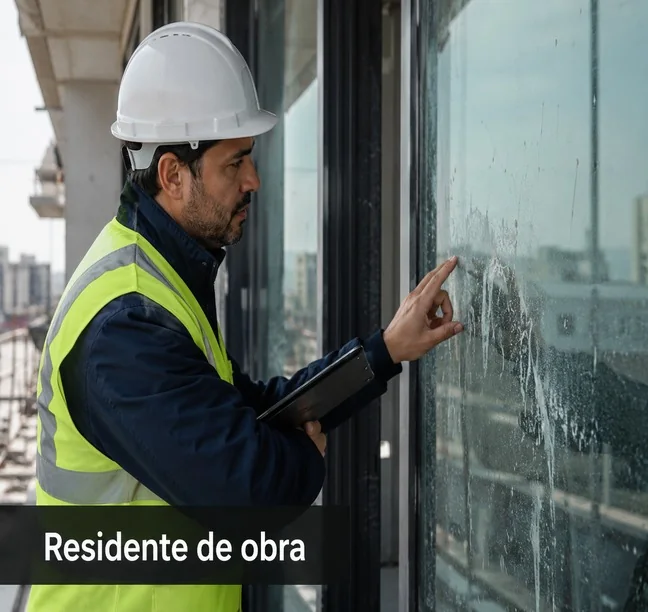
Service for construction managers dealing with glass affected by grinder sparks, pitting, or embedded points on façades and glazing systems.
Grinding particles can appear on one or several work areas after metalwork, when finishes are already installed and access is shared with other crews.
Immediate impact
The rough texture and embedded points prevent area release and require coordination of safety, crews, platforms, or scaffolding.
What can happen if it is ignored
Late replacement can stop work sequences, reopen façades, and cause collateral damage to seals, profiles, or finishes.
Technical cause of the damage
Cutting or grinding projects hot abrasive particles that embed in the glass and form craters. The damage pattern can reveal the source work area and helps plan crews, platforms, and protection.
Common alternatives and hidden costs
Late replacement interferes with seals, finishes, and work sequences. Cleaning does not remove the rough texture. A work-area-based intervention reduces handling and makes it possible to coordinate productivity with glazing and safety teams.
Benefits of evaluating restoration
- Planning by work fronts and levels
- Coordination with glazing contractors and safety teams
- Productivity estimation by surface area
- Reduction of dismantling operations
Service process
- We map affected panes, assign access requirements and safe work areas, protect frames, restore by modules, and release areas after visual quality control so the project can continue without creating new punch-list items.
Scope and limitations
For grinding-spark damage, there is usually an approximate working limitation of 7 to 10 cm from certain edges. The diagnosis distinguishes this damage from welding burns, hard-water scale, or removable contamination.
We do not work on broken, cracked, fractured or structurally damaged glass. We restore deep damage when the glass is not broken or cracked. Depth changes the work time and sequence, but it does not rule out recovery.
Review my case Change profile or selection
Frequently asked questions
Is the work performed with the glass installed?
Yes. We work with the glass installed as long as it remains intact and safe access is available, avoiding removal and reducing disruption to your space.
Can tempered glass be restored?
We restore tempered glass with superficial or deep damage as long as the glass is not broken, cracked, fractured or structurally compromised.
Does the glass become distorted or weakened?
The specialized process recovers the surface in a controlled manner without distorting the glass or altering its function. Before starting, we confirm the scope using the case’s technical information.
Can deep damage be restored?
Yes. We restore deep damage when the glass remains intact; depth determines the work sequence and time, but by itself does not require replacement.
How is the price determined?
It depends on the type and depth damage, area, number of panes, access, height, location, sector and volume.
When is restoration not possible?
We do not work on broken, cracked, fractured glass or damage that structurally compromises the glass.
What information do you need for an evaluation?
Damage type, location, quantity or area, access conditions and case-specific information. We do not request photographs in the first contact.
Is it worth evaluating before replacement?
Yes. Technical confirmation makes it possible to compare scope, timing, operational risks and direct and indirect costs against replacement.
What happens if a pane cannot withstand the process?
This is very uncommon because Grupo GNOVIA personnel are trained to restore glass using a controlled sequence. In exceptional cases, previously damaged glass may not withstand the intervention. If that occurs, we do not charge for the service performed on that pane; however, we do not assume the replacement cost of glass that was already damaged before work began. This condition is explained clearly before the work starts.
Do you need an on-site visit to confirm the service?
Not in most cases. We can confirm service remotely using the damage description, dimensions, glass type, location, and access conditions. On-site visits are primarily reserved for construction projects or projects involving a large volume of glass.