When the shower enclosure still looks dirty after housekeeping has cleaned it
Service for housekeeping teams dealing with cloudy glass enclosures, hard-water scale, and white stains that generate recurring guest reports.
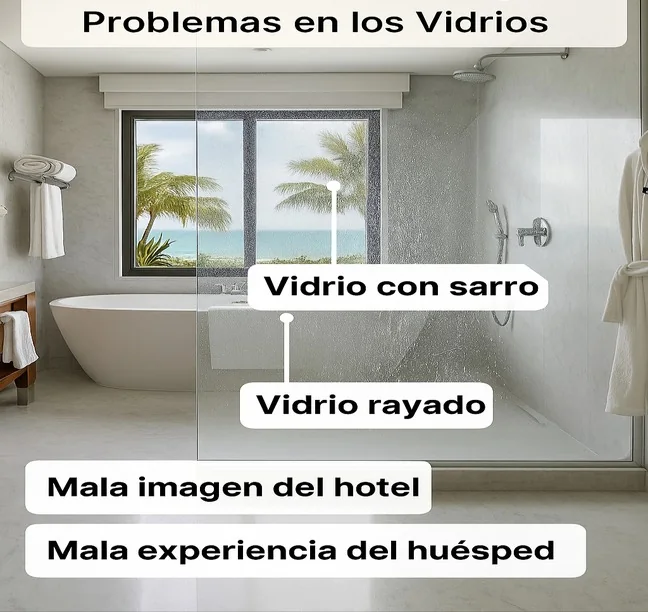
The glass enclosure looks whitish or poorly maintained immediately after cleaning, and guests may interpret it as a lack of care.
Immediate impact
Reports, rework, and chemical use increase while the room still fails to meet the visual standard.
What can happen if it is ignored
Deposits can become more established and affect additional rooms, increasing maintenance and replacement costs.
Technical cause of the damage
Calcium, magnesium, soap, and moisture create a film that housekeeping cannot remove with the normal routine. Distinguishing dirt from surface damage avoids rework and excessive chemical use.
Common alternatives and hidden costs
Assigning more cleaning time will not recover an affected glass surface; replacing shower enclosures takes rooms out of service. Restoration corrects the interior face and gives the team a clear visual reference for the expected standard.
Benefits of evaluating restoration
- Diagnosis to distinguish dirt from surface damage
- Intervention coordinated with occupancy
- Noticeable improvement in transparency
- Guidance to reduce the use of unsuitable products and fibers
Service process
- We select rooms, protect fixtures and stone, work on the interior face of the shower enclosure, review transparency, and coordinate handover so housekeeping can resume its routine without residue.
Scope and limitations
We distinguish between removable deposits and surface alterations. Household chemicals do not always correct the damage and can make it worse, so evaluation is advisable before continuing to apply products.
We do not work on broken, cracked, fractured or structurally damaged glass. We restore deep damage when the glass is not broken or cracked. Depth changes the work time and sequence, but it does not rule out recovery.
Review my case Change profile or selection
Frequently asked questions
Is the work performed with the glass installed?
Yes. We work with the glass installed as long as it remains intact and safe access is available, avoiding removal and reducing disruption to your space.
Can tempered glass be restored?
We restore tempered glass with superficial or deep damage as long as the glass is not broken, cracked, fractured or structurally compromised.
Does the glass become distorted or weakened?
The specialized process recovers the surface in a controlled manner without distorting the glass or altering its function. Before starting, we confirm the scope using the case’s technical information.
Can deep damage be restored?
Yes. We restore deep damage when the glass remains intact; depth determines the work sequence and time, but by itself does not require replacement.
How is the price determined?
It depends on the type and depth damage, area, number of panes, access, height, location, sector and volume.
When is restoration not possible?
We do not work on broken, cracked, fractured glass or damage that structurally compromises the glass.
What information do you need for an evaluation?
Damage type, location, quantity or area, access conditions and case-specific information. We do not request photographs in the first contact.
Is it worth evaluating before replacement?
Yes. Technical confirmation makes it possible to compare scope, timing, operational risks and direct and indirect costs against replacement.
What happens if a pane cannot withstand the process?
This is very uncommon because Grupo GNOVIA personnel are trained to restore glass using a controlled sequence. In exceptional cases, previously damaged glass may not withstand the intervention. If that occurs, we do not charge for the service performed on that pane; however, we do not assume the replacement cost of glass that was already damaged before work began. This condition is explained clearly before the work starts.
Do you need an on-site visit to confirm the service?
Not in most cases. We can confirm service remotely using the damage description, dimensions, glass type, location, and access conditions. On-site visits are primarily reserved for construction projects or projects involving a large volume of glass.