Your scratched glass table can look impeccable again
We restore scratches on the top face of glass tables and desks to preserve the original pane and avoid fabricating a new custom piece.
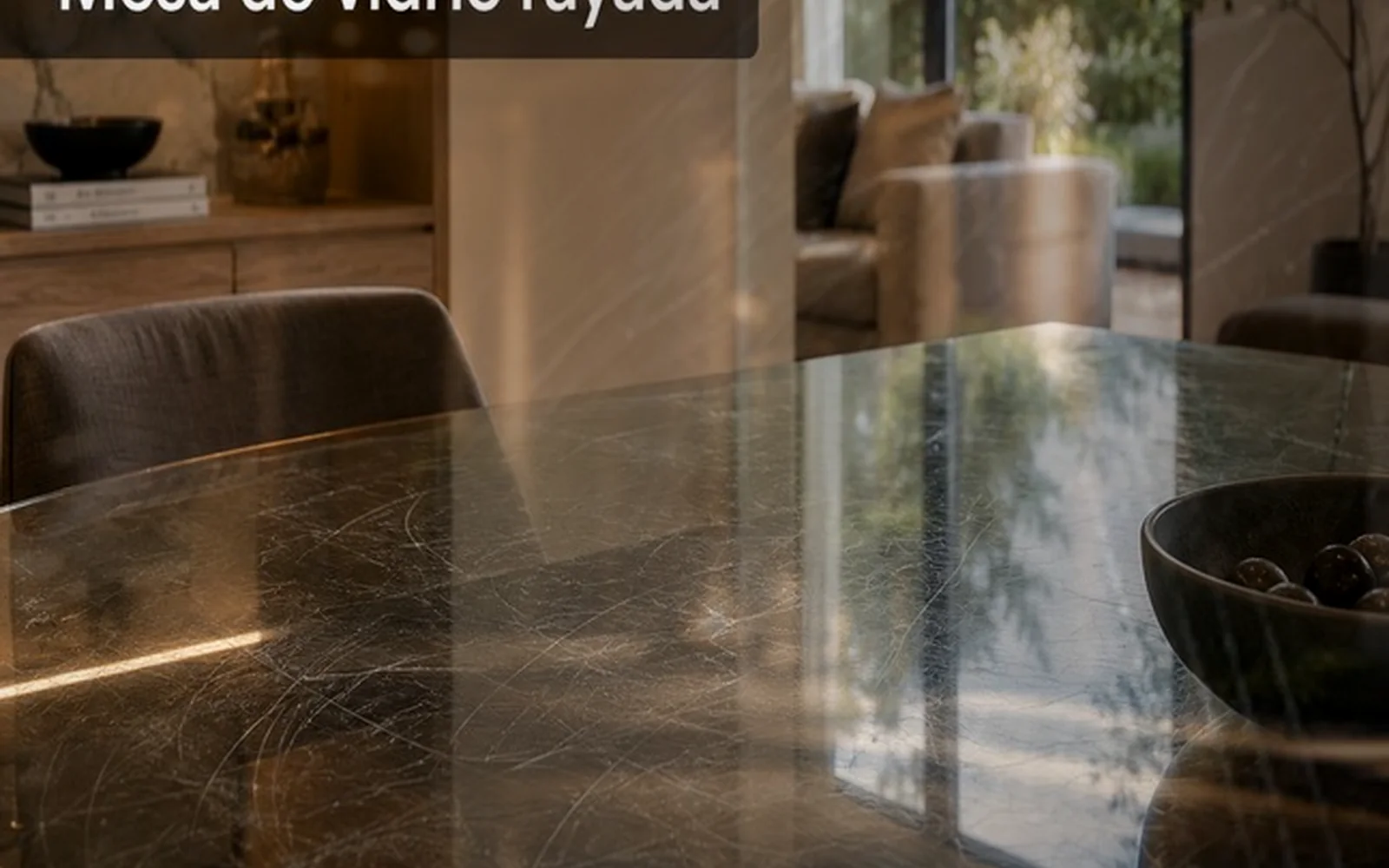
Scratches on a glass table are visible exactly where appearance matters most: under lighting, in front of guests, and during everyday use. Even when the pane remains intact, it loses the finish that justified its value.
What is happening to your glass
Tableware, metal objects, abrasive cleaning, fine dust, and repeated movement can leave intersecting lines that become more noticeable against dark backgrounds or under focused lighting.
Why it affects appearance so much
The surface conveys wear and affects the appearance of dining rooms, offices, boardrooms, or designer furniture. With custom tempered panes, replacement may not reproduce the original edge, tint, or hole pattern exactly.
What leaving it or replacing it implies
Covering the table hides the problem temporarily but defeats the visual purpose of the glass. Fabricating another pane involves dimensions, a template, tempering, transport, and handling a heavy component.
How we restore this pane
- Restoration exclusively on the top face
- Preservation of original dimensions, edges, and holes
- Recovery of deep scratches while the pane remains intact
- Direct alternative to fabricating a new custom-sized glass pane
Process specific to this case
- We confirm the dimensions, thickness, and whether the glass is tempered.
- We protect the base, wood, stone, metal, and nearby furniture.
- We work only on the top face, where use and wear are concentrated.
- We review the surface under grazing light to confirm uniformity.
Deep damage and work limitations
On glass tables we restore the top face, not both faces. Deep scratches can be corrected while the pane remains intact; near edges, the approximate 4-to-7-cm working limitation for scratches is respected.
Grupo GNOVIA restores superficial and deep damage when the glass remains intact. Most cases are confirmed using technical information; on-site visits are mainly reserved for large volumes.
Frequently asked questions about this case
Do you work on tempered-glass tables?
Yes. We confirm thickness, dimensions, edges, and overall condition before scheduling the intervention.
Is the underside restored?
No. Standard service is performed only on the top face, which is the exposed and scratched surface.
Do I need to remove the glass the base?
In many cases, no. We review stability, access, and protection of the base to determine a safe way to work.
What information do you need to continue?
Approximate dimensions, thickness if known, table type, location, and a description of the scratches.
What happens if a pane cannot withstand the process?
This is very uncommon because Grupo GNOVIA personnel are trained to restore glass using a controlled sequence. In exceptional cases, previously damaged glass may not withstand the intervention. If that occurs, we do not charge for the service performed on that pane; however, we do not assume the replacement cost of glass that was already damaged before work began. This condition is explained clearly before the work starts.
What annealed-glass thickness do you recommend?
We do not recommend restoring 6 mm annealed glass because its lower strength makes it less likely to withstand the process. Annealed glass 9 mm or thicker has a greater probability of withstanding the intervention; even so, service is performed only under the client’s responsibility and with prior acceptance of this condition. Broken, chipped, or fractured glass is not treated.
Do you need an on-site visit to confirm the service?
Not in most cases. We can confirm service remotely using the damage description, dimensions, glass type, location, and access conditions. On-site visits are primarily reserved for construction projects or projects involving a large volume of glass.