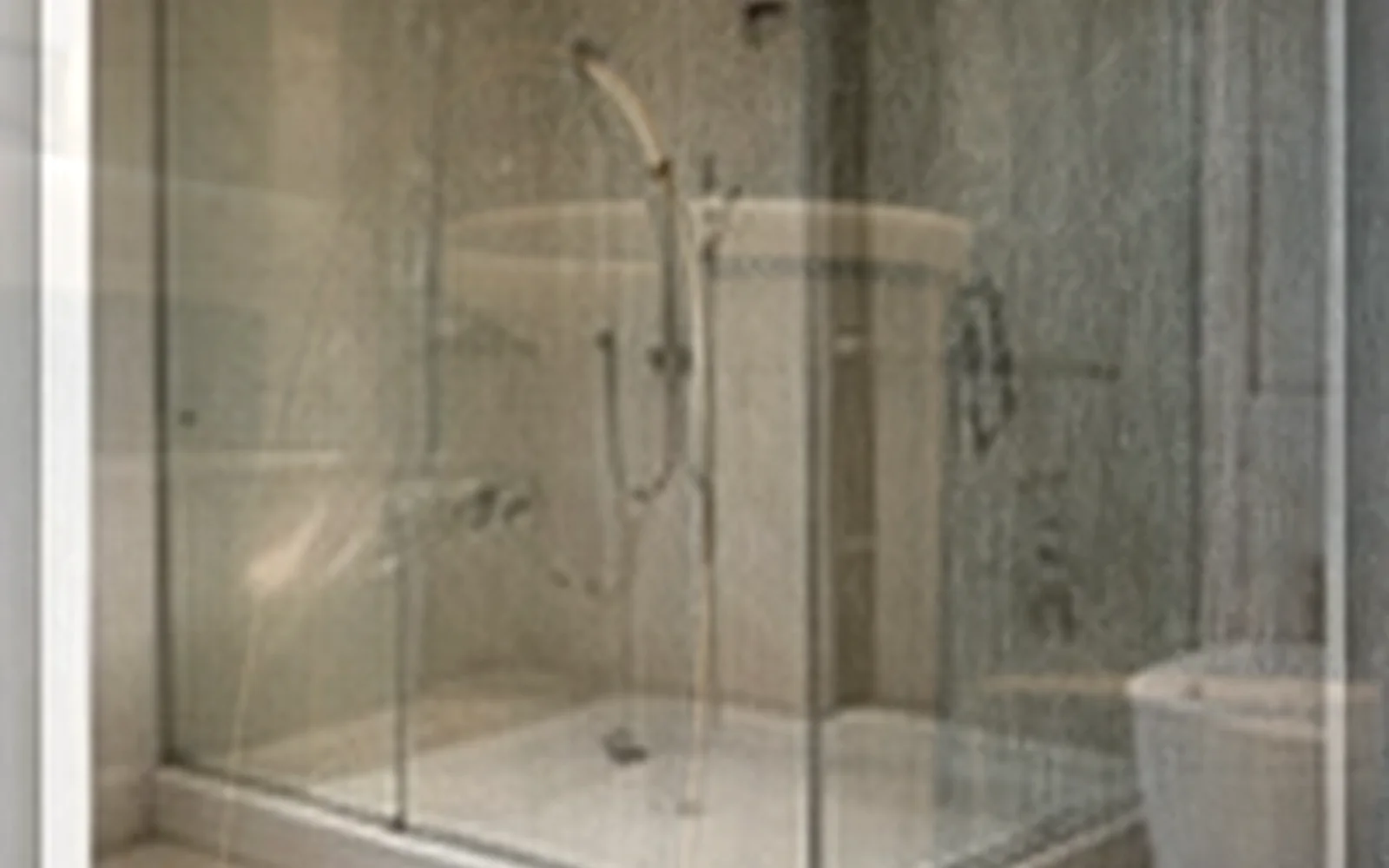
Remove the cloudy appearance from your shower enclosure
We restore the interior face of shower enclosures clouded by hard-water scale, calcium, and soap residue to recover transparency and a clean appearance.
When a shower enclosure remains white and cloudy after cleaning, the bathroom can look neglected even when it is spotless. The problem is no longer ordinary dirt: minerals and residue adhere to the glass and can alter the surface.
What is happening to your glass
Hard water, calcium, magnesium, soap, constant moisture, and cleaning products can create layers that accumulate on the interior face of the glass. Over time, transparency is lost and rough or whitish areas appear.
Why it affects appearance so much
Cloudy glass reduces the sense of openness, diffuses light irregularly, and can make the bathroom look older. Strong chemicals and aggressive pads may make the haze worse.
What leaving it or replacing it implies
Continuing to apply household products consumes time and can attack hardware, seals, or stone. Replacing the glass enclosure requires intervention on frames and silicone joints that are still functioning properly.
How we restore this pane
- Restoration of the interior face, where hard-water scale is concentrated
- Recovery of transparency without replacing hardware
- Correction of deposits and surface alteration
- Protection of stone, fixtures, seals, and finishes
Process specific to this case
- We identify deposits, haze, and areas with surface attack.
- We protect metals, natural stone, and sensitive surfaces.
- We work on the interior face of the shower enclosure in controlled sections.
- We verify clarity and uniformity after removing process residue.
Deep damage and work limitations
Restoration is performed on the interior face, which receives water and soap. We restore severe buildup and surface damage as long as the glass is not broken, chipped, or fractured.
Grupo GNOVIA restores superficial and deep damage when the glass remains intact. Most cases are confirmed using technical information; on-site visits are mainly reserved for large volumes.
Frequently asked questions about this case
Why does hard-water scale not come off with ordinary cleaners?
Because minerals can bond strongly to or react with the surface. Once haze is present, repeating ordinary cleaning does not correct the damage.
Which side the glass enclosure is restored?
The interior face, which receives water, soap, and moisture. That is the surface included in the standard service.
Do you protect stone and hardware?
Yes. Before starting, we isolate fixtures, profiles, seals, and sensitive bathroom materials.
How can I reduce recurrence?
After the service, it is advisable to remove standing water, use suitable products, and maintain a routine that prevents prolonged buildup.
What happens if a pane cannot withstand the process?
This is very uncommon because Grupo GNOVIA personnel are trained to restore glass using a controlled sequence. In exceptional cases, previously damaged glass may not withstand the intervention. If that occurs, we do not charge for the service performed on that pane; however, we do not assume the replacement cost of glass that was already damaged before work began. This condition is explained clearly before the work starts.
What annealed-glass thickness do you recommend?
We do not recommend restoring 6 mm annealed glass because its lower strength makes it less likely to withstand the process. Annealed glass 9 mm or thicker has a greater probability of withstanding the intervention; even so, service is performed only under the client’s responsibility and with prior acceptance of this condition. Broken, chipped, or fractured glass is not treated.
Do you need an on-site visit to confirm the service?
Not in most cases. We can confirm service remotely using the damage description, dimensions, glass type, location, and access conditions. On-site visits are primarily reserved for construction projects or projects involving a large volume of glass.